
Abraham de Moivre
 2026-01-21 09:31:09
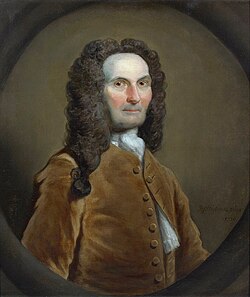
Abraham de Moivre (Vitry-le-François, France, May 26, 1667 – November 27, 1754, London) was a French-born English mathematician who made fundamental contributions to probability theory and analysis. He is known for discovering Moivre's formula for complex numbers, the first description of the normal distribution, the proof of a special case of the central limit theorem (the Moivre-Laplace theorem), and his work on gambling theory, actuarial mathematics, and recurring sequences. He was a student and assistant of Isaac Newton. He served on the commission that resolved the Newton-Leibniz priority dispute (1710). He published works on analysis, "The Method of Fluxions" (1695), on probability theory, "The Doctrine of Chances: A Method of Calculating the Probabilities of Events in Play" (1718), a probabilistic-statistical study, "Annuities on Lives" (1724), and on analysis, "Miscellanea Analytica" (1730), which first introduced Stirling's formula. He was a member of the Royal Society of London (1697), the Paris Academies of Sciences (1754), and the Berlin Academies of Sciences (1735).