
Nikolai Poklonsky
 2026-01-21 09:31:26
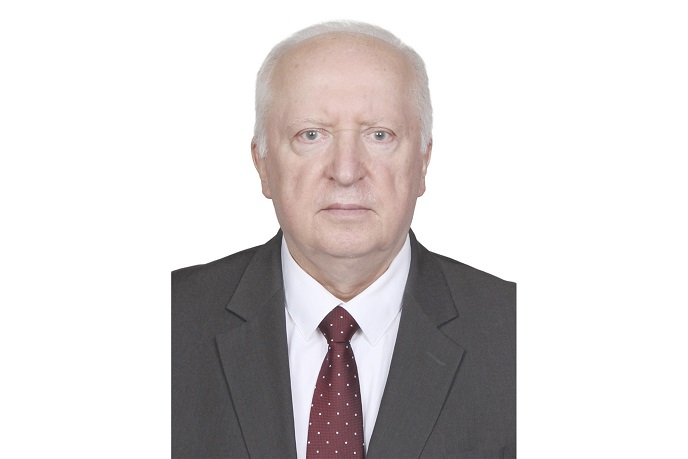
Nikolai Poklonsky (Gorodok, USSR, August 14, 1949) is a Belarusian physicist and one of the most respected experts in the physics and electronics of semiconductor systems in Belarus. He is a Corresponding Member of the National Academy of Sciences of Belarus and a Foreign Member of the Russian Academy of Sciences (2022). He is a professor and Doctor of Physical and Mathematical Sciences. He works at the Department of Semiconductor Physics and Nanoelectronics at Belarusian State University (1993). In the field of macro- and microsystems, he developed the theory of ionization equilibrium, hopping electrical conductivity, and thermopower for semiconductors with point defects in the crystal structure. He discovered the absorption of microwave electromagnetic radiation by electrons levitating above the surface of a natural diamond during its photoexcitation in the fundamental absorption region. In synthetic diamonds at room temperature, he discovered the maser effect on nitrogen impurity atoms. In diamonds exposed to radiation, he discovered quasi-ferromagnetism - the magnetic activity of crystal structure defects. He designed and manufactured a microwave resonator for measuring the magnetic and electrical parameters of materials, a memory cell based on a vertical bipolar transistor with an amorphous silicon collector, a broadband phase-shifting element based on a silicon carbide varistor, a pressure sensor with a working substance made of finely dispersed silicon in a dielectric binder, and a resistor array based on diamond-like films modified in argon plasma. In the field of nanosystems, he predicted the Fermi resonance for fully symmetric vibrations of carbon atoms in fullerenes. He proposed a magnetically controlled electronic switch based on carbon nanotubes filled with magnetoactive endofullerenes. He was the first to show that the radiative decay of a trion in a two-dimensional crystalline quantum well is an analogue of the Auger effect. He proposed curved graphene sheets as electrodes for the decomposition of water vapor into hydroxyl radicals and hydrogen atoms. He developed a memory cell and an electromechanical generator circuit based on a graphene membrane, as well as a concept for a nanodynamometer made of a graphene bilayer with tunneling electrical conductivity between the monolayers. He was awarded the Medal "For Labor Merit" (2014), the "Excellent Education Worker" badge of the Ministry of Education of the Republic of Belarus (2019). He was awarded the A. N. Sevchenko Prize of the Belarusian State University (2008), the honorary title "Honored Worker of the Belarusian State University" (2012). Honorary Doctor of the Mongolian National University (2012).